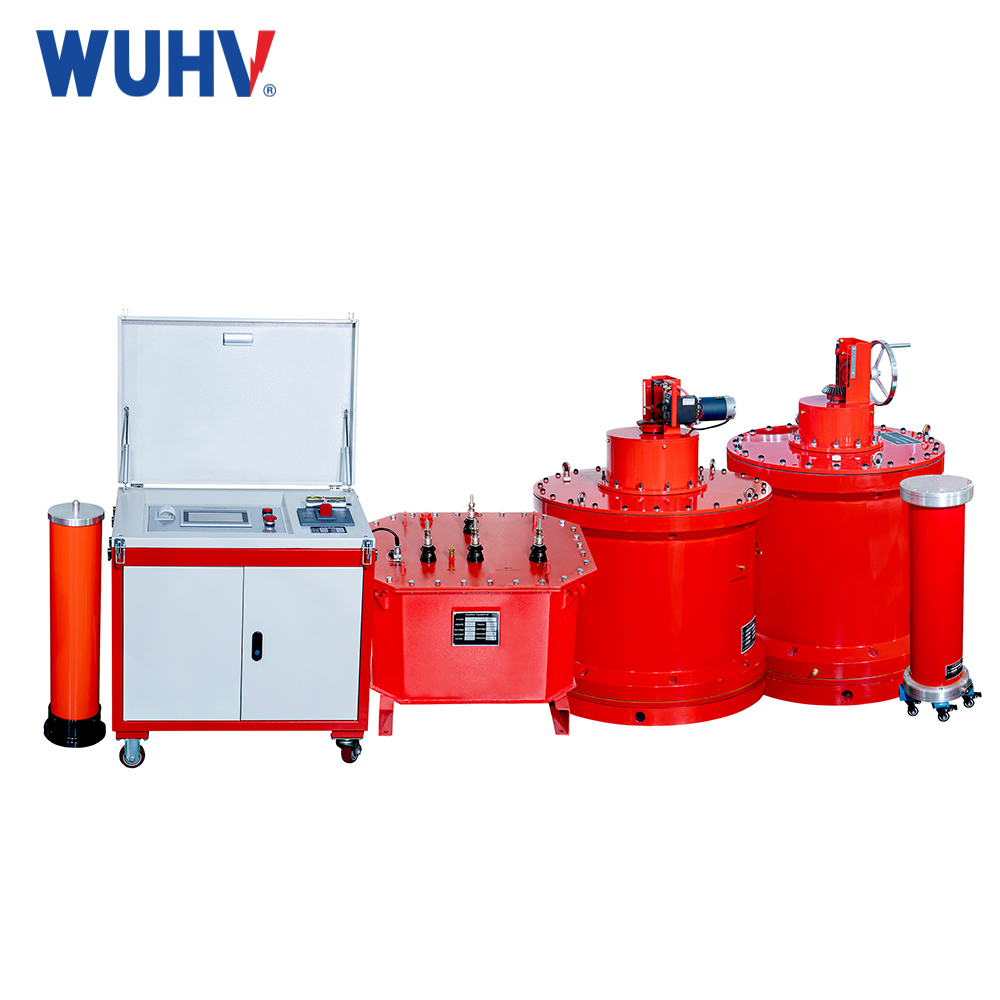
UHV(L) ഇൻഡക്ടൻസ് അഡ്ജസ്റ്റബിൾ വേരിയബിൾ ഫ്രീക്വൻസി എസി സീരീസ് റിസോണന്റ് ടെസ്റ്റ് സിസ്റ്റം is specialized, high-power AC electrical testing equipment designed primarily for testing the withstand voltage and partial discharge performance of ultra-high voltage electrical equipment like power cables, generators, transformers, Gas Insulated Switchgear (GIS), bushings, and other large-capacitance loads in HV substations and laboratories.
Its core purpose is to apply a high AC test voltage to the test object efficiently and safely, simulating operating stress, using the principle of electrical series resonance.
Key Feature: UHV(L) ഇൻഡക്ടൻസ് അഡ്ജസ്റ്റബിൾ വേരിയബിൾ ഫ്രീക്വൻസി എസി സീരീസ് റിസോണന്റ് ടെസ്റ്റ് സിസ്റ്റം allows flexible tuning of the reactors to match the specific capacitance of different test objects, enabling resonant conditions over a wide range of capacitances using a single, relatively compact set of reactors.

Advantages:
1、High Efficiency & Low Input Power: Only circuit losses need to be supplied. Power requirements are typically only 1/5th to 1/20th of traditional 50/60Hz test transformers for the same output kVA. Enables testing on-site with standard generators.
2、Smaller, Lighter, More Portable: Significantly reduced size and weight compared to massive power frequency test transformers of equivalent kVA rating. Enables mobile labs and field testing.
3、Excellent Voltage Waveform: Generates a pure, low-distortion sinusoidal test waveform matching power frequency stress, crucial for reliable PD detection and insulation diagnostics. Avoids DC testing limitations for XLPE cables.
4、Intrinsic Safety: Flashover or breakdown of the test object causes a loss of resonance. This instantly collapses the HV circuit voltage (V_Cx drops rapidly towards zero) and limits fault current.
5、Gradual Voltage Application: Precise ramp-up/ramp-down control is inherent.
Automatic Tuning: Modern systems automate frequency sweep and resonance finding.
6、Minimal Test Object Damage: The instant voltage collapse on breakdown limits energy discharge into the fault.
7、Versatility (Thanks to Adjustable L): Taps allow optimal resonance for a wide range of test object capacitances with one set of reactors. Ideal for labs testing diverse equipment types/sizes.
8、Superior for XLPE Cables: Considered the standard method for testing modern extruded dielectric cables due to waveform suitability and effectiveness in revealing water treeing issues.
Disadvantages:
1、Higher Initial Cost: More complex electronics and precise reactors lead to higher purchase cost than simpler DC or low-power VLF (0.1Hz) sets (though cheaper than equivalent kVA transformer sets).
2、Complexity: Involves sensitive electronics, control systems, and precise reactor tuning. Requires trained personnel.
3、Frequency Sensitivity: Test voltage magnitude depends critically on maintaining exact resonance. Drift in L or Cx (e.g., temperature) requires retuning or compensation. Load shifts during PD events can distort the waveform or voltage reading.
4、Tuning Time: Though automated, the initial tuning sweep can take minutes, especially for high-Q circuits. Fixed-frequency systems are faster if matched perfectly to a known Cx.
5、Limited to Capacitive Loads: Requires a predominantly capacitive test object. Primarily resistive or inductive loads are inefficient or impractical.
PD Calibration Challenges: Precise PD measurement requires careful calibration due to the resonance tank's high Q and the reactive components involved.
6、Harmonic Sensitivity: Poor VF source waveform or non-linearities can excite harmonic resonances, distorting the output waveform.
Key Application Scenarios:
1、Factory Acceptance Testing (FAT): Final proof testing of new HV equipment (cables, transformers, GIS, reactors, bushings).
2、Site Acceptance Testing (SAT): Verification after installation at substations or along transmission lines.
3、HV Power Cable Testing:
Commissioning tests (AC withstand & PD) for MV and HV transmission cables (land & submarine).
After-laying tests.
Diagnostic testing and routine maintenance of cable systems.
4、GIS Testing: Commissioning and maintenance tests, including integrated circuits and PD detection.
5、Rotating Machine Testing (Generators & Motors): AC withstand testing of stator windings.
6、Transformer & Reactor Testing: AC withstand voltage testing of windings, bushings, tap changers.
7、Research & Development Labs: Investigating insulation materials and HV component designs under AC stress.
8、Utility Maintenance Programs: Proactive condition assessment of critical HV assets.